
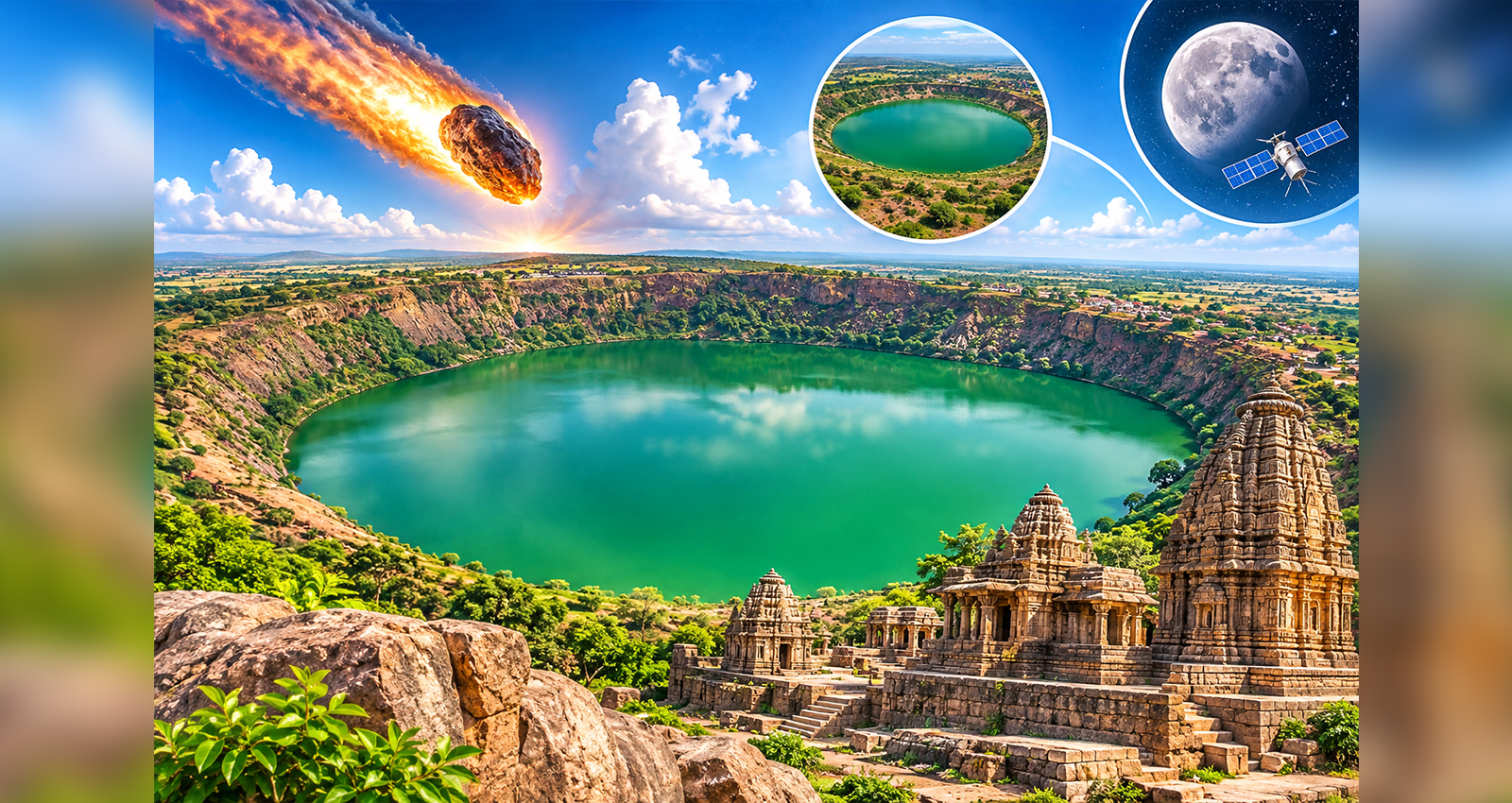
THE LAKE THAT FELL FROM THE SKY
India’s Hidden Wonder — Lonar Crater Lake, Maharashtra
India is famous for wonders built by kings — forts, palaces and temples. But what if I told you that one of India’s greatest wonders was not built by anyone? It fell from the sky. In a small village called Lonar, in Buldhana district of Maharashtra, there is a lake that looks like a giant green eye from above. It was not made by digging. It was made by a meteor that crashed to Earth 52,000 years ago. This is Lonar Crater Lake — the lake that fell from the sky.1. A Cosmic Accident
Around 52,000 years ago, when early humans were still living in caves, a huge rock from space was travelling at a speed of about 90,000 km per hour. It hit the Deccan Plateau with tremendous force. The impact created a perfect round crater — 1.8 km wide and 150 metres deep. Over thousands of years, rainwater filled the crater and formed a lake. Today, Lonar is the world’s third-largest crater lake formed by a meteor impact, and one of only four hyper-alkaline soda lakes in the world.2. A Scientific Wonder
Scientists from NASA and ISRO come to Lonar to study it because its soil is very similar to the soil found on the Moon and Mars. The water of Lonar is both salty and alkaline at the same time — a rare combination. Because of this, special micro-organisms live here that are found nowhere else on Earth. In June 2020, the whole world was surprised when Lonar Lake suddenly turned PINK overnight. Scientists later found it was due to a rare algae bloom.3. A Mythological Mystery
According to legend, this is the place where Lord Vishnu killed the demon Lonasura. The demon’s blood became the salty water, and his huge body created the crater. The name Lonar itself comes from Lavanar, meaning salt. Around the lake, there are 14 ancient temples built between the 6th and 12th centuries by Chalukya and Yadava kings.4. Why Is It Still Hidden?
Lonar is only 140 km from Aurangabad, yet very few tourists visit it. There are no big hotels, no shopping malls, no crowds. There is only a quiet village, a forest full of peacocks, langurs and migratory birds, and a calm, mysterious lake.5. A Live Classroom for Students Geography: How craters are formed Science: How life survives in extreme water History: Chalukya and Yadava temples Mythology: How our ancestors explained science through stories Conclusion
We teach our children about the Grand Canyon in America and craters on the Moon. But we forget that India has its own crater — right here in Maharashtra. Lonar reminds us that India’s greatest wonders are not always built. Some just fall from the sky and wait quietly for thousands of years to be discovered. Moral: We must preserve and protect our natural heritage and historical monuments for future generations.
S. Nithya Priya, Mentor
Previous Story
Let us care nature
Next Story